Justincredible Prototype
Bodywork & movement · Big Island, Hawaii

Use your body without breaking it.

It's simpler than you think.

I work with people who have already tried everything. Doctors, physical therapy, the apps, the stretches, the guy their friend swore by. And they still hurt.
Why this hero
This is the only line he generated himself in the interview, and he recognized it as right the moment he said it. "Use your body without breaking it. It's simpler than you think." It promises a capability, not a cure, which keeps him legally and ethically clean. The second button sends people to the disclaimer instead of to booking on purpose: this audience has been burned and will not convert on first contact. Sending them toward the honest part is the faster path to trust.
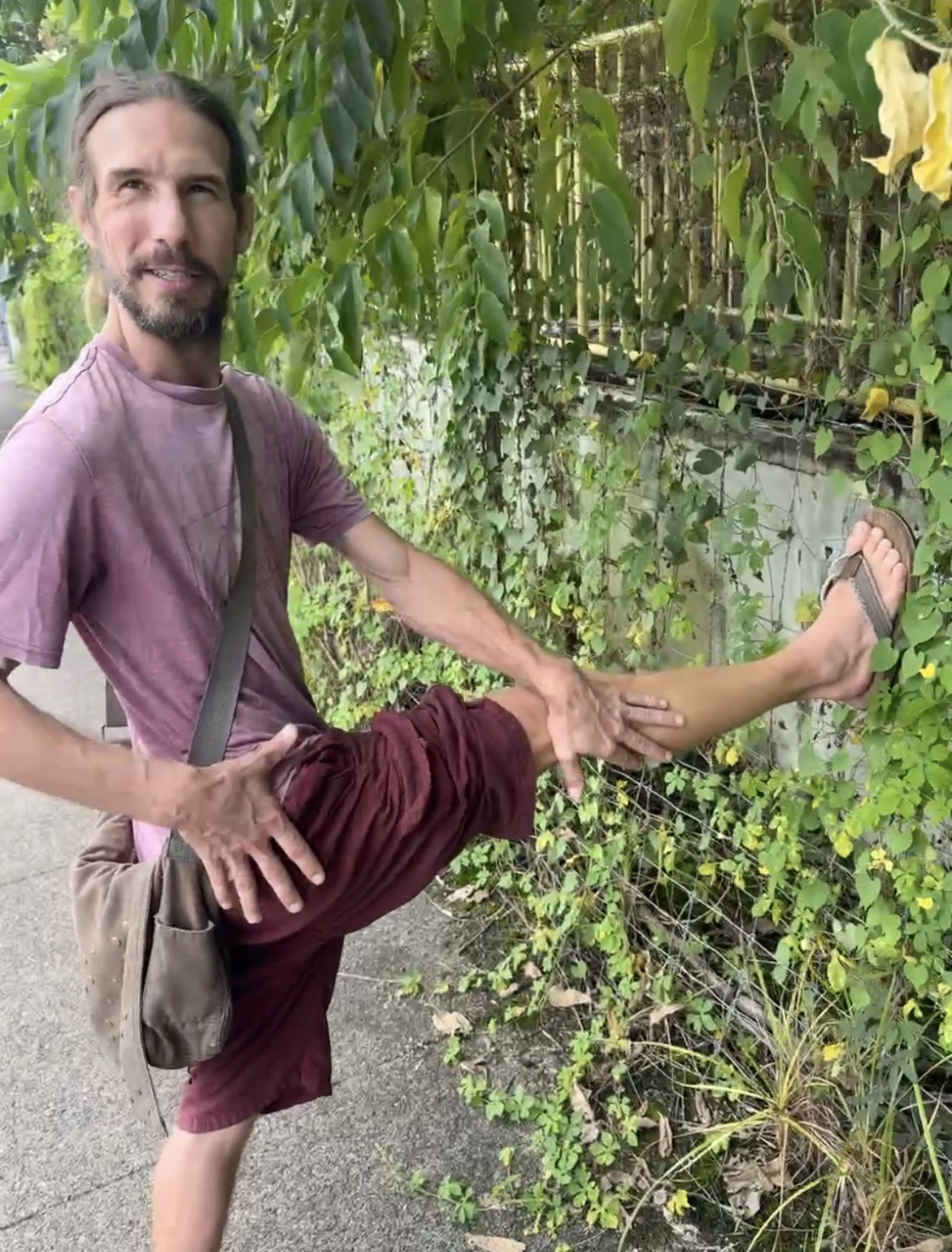
Xander outdoors, one leg raised onto a wall, mid-sentence, surrounded by green.
About this photo
This is a frame from a video, used as a placeholder, and it is doing better than most shot photography would. He is outdoors, mid-sentence, demonstrating rather than posing, and looking off camera rather than into it. That is exactly the brief. When a real shoot happens, keep those four things and change only the sharpness. No hands-on-a-back wellness imagery, and never eyes-closed serene.
Who I work with

“It's impossible. I've tried everything and nothing works.”

That is what people say to me right before we start. And that is exactly the person I want to work with.

You have probably been told it is structural. Or that it is just age. Or that the scan is clean so there is nothing wrong. You have a sheet of exercises somewhere that you did for a while and stopped, because nothing changed.

I am not going to tell you it is in your head, and I am not going to tell you that you are broken.

“There's nothing wrong to fix. You're just turned around. It's more of a confusion than a brokenness.”
Why this comes second
Someone who has been let down repeatedly will not accept a claim until they accept that you understand the problem. Leading with their sentence in quotation marks, rather than his, does that work in one line. "Turned around, not broken" is the reframe the rest of the page depends on: it moves a person from damaged goods to someone with a navigation problem, which is solvable and carries no shame.
What I don't claim

Massage does not fix anything.

I say this to everyone, so I will say it here too.

Hands-on work does not fix the thing. What it does is speed up whatever you are already doing about it. If you are moving differently and paying attention to how you sit and stand and lift, the hands-on work makes that go faster. If you are not doing anything, it makes nothing go faster.

You put it there. If you do not stop doing the thing that put it there, it is coming back, no matter how much bodywork you get. What I can do is make it easier for you to stop doing that thing.

Why the disclaimer is a selling point
Every competitor promises relief in this slot. Putting the limit here, third, before any offer, is the risk reversal the whole page runs on. It reads as the only honest page they have landed on all week. It also pre-qualifies: the passive buyer who wants to be worked on and leave will bounce here, which is exactly what he wants, since that is the client type he says drains him.
How it works

Four steps, then we throw them out.

This is the same process whether we are working on your back, your training, or something that is not physical at all. That is the point of it.

01

You find out what you are doing

We start with your part in it. Most chronic pain is something you are doing, over and over, without knowing you are doing it. Until you can see that, nothing else works.

02

You learn to read the signal

Sensation is information. Your body is telling you something and the question is whether you are listening. Not whether you are doing it right.

03

You get something small to do

One thing. Not a program, not a sheet of twelve exercises. Something small enough that you will actually do it, aimed at the specific thing you are doing to yourself.

04

We scrap it and start over

When it works, you are not the same person anymore, so the plan is not right anymore. That system got you here. It is not valid from here. So we forget it and start again from wherever you actually are.

“If it's not applicable in every way of your life, it's probably not going to help you anywhere in life.”
Why four steps and why step four is unusual
He described this method twice in the interview and was not sure himself how many steps it was. Jacob mapped it to change management on the call: discover, plan, execute, monitor, repeat. Step four is the differentiator and no competitor has it. Most practitioners sell you a system and keep you on it. He builds one and then deliberately destroys it, because staying on it would mean you stopped changing. It also quietly explains why he is not trying to retain you forever.
Fit

I would rather tell you now.

This works if

  • You have had the same pain long enough to be tired of it
  • You already suspect you are doing something to cause it
  • You will try one small thing between sessions
  • You want to understand it, not just be worked on
  • You are willing to look at the parts of this you have been avoiding

This does not work if

  • You want an hour on the table and nothing to change afterward
  • You want me to fix it while you do nothing
  • Something is acute, worsening, or post-surgical. See a physician first
  • You are looking for a diagnosis. That is not what this is
Why say no on the page
His single biggest drain, in his words, is people who do not do the thing he asks and come back unchanged: "I'm literally just recycling the experience over and over again with no progress." A fit section is cheaper than that conversation and it converts better, because a person who has been oversold everywhere else reads a real "no" as proof the "yes" means something. There is a tension to watch: his stated audience is desperate and hopeless, and desperate people are sometimes not yet able to do the work. This section is the screen.
After the session

I check on you. Three times.

Most people walk out and I never hear how it went. So this is built in now, and it costs you nothing.

Day 2

A text. Did anything change, did anything come back, and did you do the one thing.

Day 10

A text. What is different now that a week has passed, and does the small thing need adjusting.

Day 45

A text. Did it hold. If it held, you probably do not need me again, and that is the goal.
Why this section exists at all
This is the most important addition on the page and it is not really marketing. The root of his confidence problem, in his own words, is that nobody reports back: "I don't even know if any of this stuff really helps people. Nothing really comes back." He cannot tell whether he succeeded or was irrelevant. Three scheduled texts fix more of that than any amount of encouragement, and they generate the testimonials he currently does not have. Note he has lost every past testimonial, so this section builds proof rather than displaying proof he cannot produce.
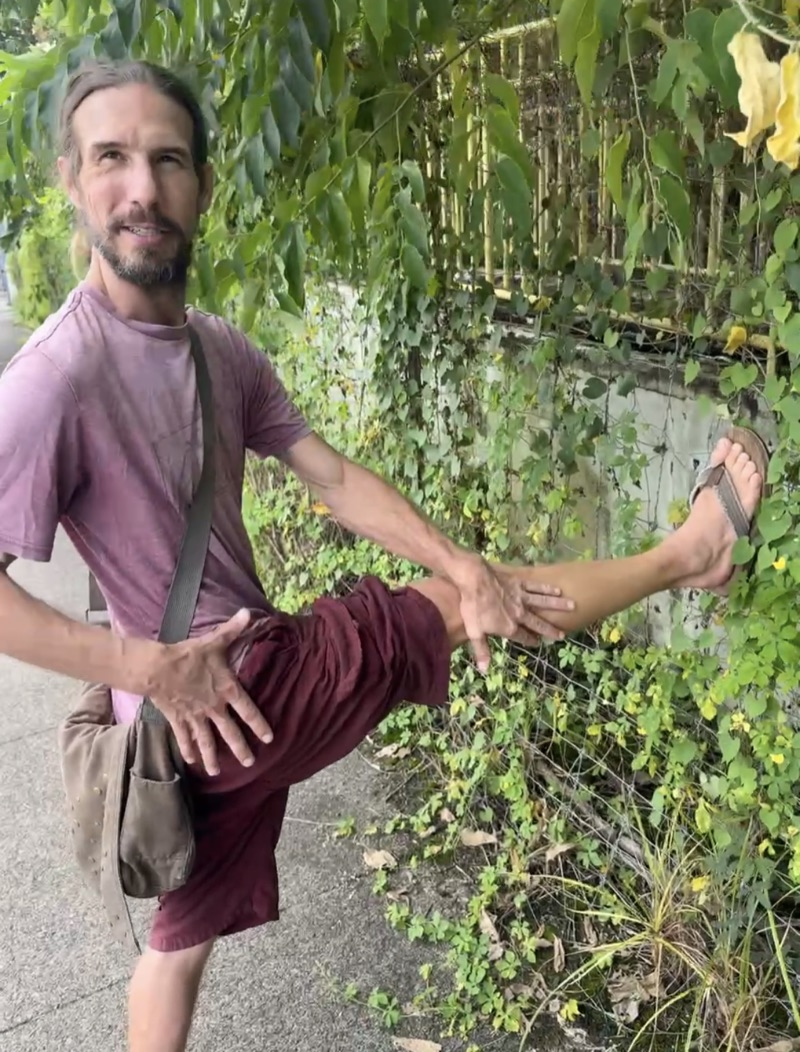
Xander demonstrating a standing stretch outdoors.
Who I am

The name came from what people said on the way out.

People kept finishing a session and saying "that was incredible." My name is Justin. So: Justincredible. I did not pick it, it just stuck.

I had the certifications. The big national ones. I let all of them lapse on purpose, because what they were teaching was narrow and overcomplicated, and it did not describe what I actually do. I would rather you shape your own way than get certified in mine.

I have broken most of my body at one point or another. It all works now. That is not a promise about you, it is just the reason I believe this is learnable.

“I am committed to choosing to be myself regardless of the situation.”
Why the lapsed certifications are stated, not hidden
He wrote "FUCK A CERT" on his intake form. The transcript shows the real argument: he holds the top national certifications, let them lapse deliberately, and objects that they are narrow and that anyone can invent one and sell it. Framed as "I did the certs and let them go, here is why," that is credibility. Framed as "I never bothered," it reads as evasion to a buyer who has been burned. The order matters. Note also: his rebuilt body is offered as a reason for belief, carefully not as a claim about the reader.
What it costs

One rate. Everything.

$100 / hour

Hands-on, movement, or both in the same hour. I do not price them differently because they are not different.

PaymentZelle or cash
BookingText me directly
WhereBig Island, Hawaii

If one session does nothing, do not book another. Best advice I ever got, and I hold myself to it. If you walk out and nothing measurably changed, do not come back to me. Go find the thing that does work.

Why one price and why the guarantee is worded that way
He charges $100 deliberately: high enough that people pay attention, low enough to stay accessible. He privately believes the work is worth $300 and prices low on principle, which is worth respecting rather than overriding on day one. The guarantee is his own standard, quoted almost verbatim from the interview, and no competitor will match it. Longer term the strategy is to move away from selling a bare hour, because an hour invites comparison to any other hour of labour. Packages, courses and access tiers all price the outcome instead.

Tell me what hurts.

Text me what is going on and how long it has been going on. I will tell you straight whether I think I can help, and if I do not think I can, I will say that instead of booking you.

Text (808) 555-0000
Why text and not a booking form
He has no booking software, no reliable internet, and takes Zelle and cash. A calendar embed would be a lie. Text is what he actually uses and it matches how word of mouth already reaches him. The prefilled message body lowers the hardest part, which is a stranger in pain having to compose an opening line. The number here is a placeholder and must be replaced before this goes anywhere near a real visitor.
Filming now · Episode 1 lands [DATE]

Twelve weeks. One back. Filmed.

I am working on one person, once a week, for twelve weeks, and recording every session. You get to watch the whole thing, including the weeks where nothing happens.

His name is Jacob. He sits at a screen for a living, his back hurts, and he has never done anything about it. That is most people.

Why lead with the honest status
Nothing has been filmed yet. A page that says "watch the series" over zero episodes would break the exact thing that makes this site work, which is that he does not claim what is not true. The status strip turns a weakness into the hook: you are early, and you get to watch it get made. Replace [DATE] once session one is scheduled.
Why film it

Nobody ever tells me if it worked.

People leave a session, and then I never hear from them again. Either it worked so well they do not need me, or it did nothing. Either way I am not being told.

So I am doing it in the open, with one person, where you can see every week whether it moved or not. If my work does not do anything, this is where that shows up.

“I don't even know if any of this stuff really helps people. Nothing really comes back.”
Why his doubt is the hook
This is almost verbatim from the discovery call and it is the most disarming thing on the whole site. Every other practitioner online is certain. A man publicly admitting he cannot tell whether his work helps, and then building a twelve week public test to find out, is unfakeable by any competitor. Do not sand this down into confidence.
What gets measured

Same five numbers. Every week. On camera.

Takes thirty seconds at the top of each session. At the end there is a chart, and the chart says whatever it says.

Week __scorecard
1Pain right now__ / 10
2Worst pain this week__ / 10
3Days he did the one thing__ / 7
4Forward fold, fingertips to floor__ in
5What changed, in his words“___”
Why an empty scorecard instead of a chart
There is no data yet, so a chart here would be invented, which is the one thing this brand cannot do. An empty scorecard is honest and still does the visual job: it shows the reader that this is a real test with a real result, and it makes the number-three row the interesting one. Compliance, not pain, is the variable nobody films. Swap this block for the real chart after week twelve.
The twelve

What we are going to do

01Where you are right nowUp next
02What you're doing to yourself
03Sensation is information
04One thing
05You didn't do the thing
06The desk is the problem
07Use your body without breaking it
08Fuck a cert
09It moved
10Now forget everything
11Doing it without me
12Six months later
Two titles worth defending
Episode 5, "You didn't do the thing," is the most valuable one in the list. Compliance is the actual subject of every coaching relationship and nobody films it, because it makes the coach look ineffective. Filming it is what makes this real rather than promotional. Episode 8, "Fuck a cert," is his own phrase from the intake form and is the best short-form candidate in the series. Fine as an episode title, and it should stay off the nav, off ads, and off anything a Google listing crawls.
The part nobody promises

If it doesn't work, I'm publishing that too.

I decided this before we filmed anything, so I cannot quietly change my mind in week nine.

If his back is the same in twelve weeks, that episode goes up and we talk about why. Maybe he did not do the work. Maybe I read it wrong. Maybe it needed something I do not do. You will get the real answer, because the alternative is another guy on the internet whose clients all get miracles.

Why commit to this in public, in advance
Stating the failure clause before filming is what makes it credible; stating it afterward would look like an excuse. It is also consistent with everything else he already believes and already says out loud: massage does not fix anything, and if one session does nothing, do not book another. The most likely real outcome is ambiguous rather than clearly good or bad, which is exactly why the compliance number on the scorecard carries as much weight as the pain number.

Watch it happen.

Free, all twelve, as they come out. No email needed for that. If you want a heads up when one lands, text me and I will tell you.

YouTube: [CHANNEL LINK]
Why no email capture here
The channel does not exist yet and neither does an email list or any tool to run one. A signup form that goes nowhere is the same lie as a booking calendar he cannot honor. Text is the only channel he actually operates today. Add proper email capture at the point where there is something to send and a tool that sends it, not before.
Does not exist yet

There is no course.

Not yet. I am not going to sell you one I have not made. What I am doing instead is filming twelve weeks of the actual work, and the course will be whatever I actually taught, in the order I actually taught it.

Why open by saying there is nothing to buy
The strongest thing this brand owns is that he does not oversell, and a pre-launch course page is where almost everyone in this category burns their credibility. Leading with "there is no course" costs one conversion today and buys the trust that makes the eventual launch work. It is also just true, and the whole site depends on being able to say true things.
What it will be

The four steps, taught properly.

Same method I use in a session, built so you can run it on yourself without me in the room. That is the actual goal.

01
Find what you're doing

Spotting your own part in it. The thing you do a hundred times a day without noticing.

02
Read the signal

Sensation as information rather than damage. What your body is saying and how to listen without panicking.

03
Pick one small thing

How to choose the single change that matters, instead of a program of twelve you will abandon.

04
Throw it out and start over

Knowing when the thing that worked has stopped being right, and rebuilding from where you actually are now.

Why the curriculum is already known
These are the four steps he described unprompted in the discovery call, so the course structure is not invented, it is transcribed. Building it out of the filmed series rather than from scratch is also the only version that will actually get made, because he cannot write about his work from memory. He can only produce it while doing it.
Before you wait for it

You might not need it.

The information is out there. Most of what I do is not secret, and a fair number of people could get most of the way there by watching the free series and paying attention.

The course is for the people who want it in order, with the reasoning attached, without having to assemble it themselves. If that is not you, take the free version and go. I would rather that than sell you something you did not need.

“I don't actually want you to have to come back to me if you don't need to.”
Why talk someone out of buying, on the sales page
This is his position, stated twice in the discovery call, and it is the most differentiated thing available to him commercially. He genuinely wants to become unnecessary to people. On a course page, that reads as confidence rather than weakness, and it pre-qualifies buyers so the ones who do purchase are the ones who will finish. It also protects the eventual high-priced tier: charging a lot for direct access is defensible precisely because the information is free elsewhere.
What it will cost

Not decided.

When it exists, the price will be here, and it will be one number with nothing hidden under it.

The seriesFree, always
The coursePrice TBD
Me, in person$100 / hour
Why the price is blank and should stay blank for now
Guessing a number here would be worse than leaving it empty. He has not decided, and the decision has real trade-offs he needs to weigh himself: he prices his hands-on work at $100 while privately believing it is worth $300, specifically because access matters more to him than margin. A course is the one product that resolves that tension instead of compromising it, since it serves many people cheaply and lets one-to-one time be priced honestly. That conversation is worth having properly with him rather than settling it by putting a number on a prototype.

Want to know when it's real?

Text me the word course. That is the whole list. I will send one message when it exists and nothing else, ever.

Text me “course”
Why a text list and not an email form
Same reason as everywhere else on this site: he has no email tool, no list, and unreliable internet. A one word text is a list he can actually run from a phone, and "one message, nothing else, ever" is a promise he can actually keep. Move to real email capture when there is a tool and someone to run it, which is a Jacob job, not a Xander job.
Prototype · v1 0 notes